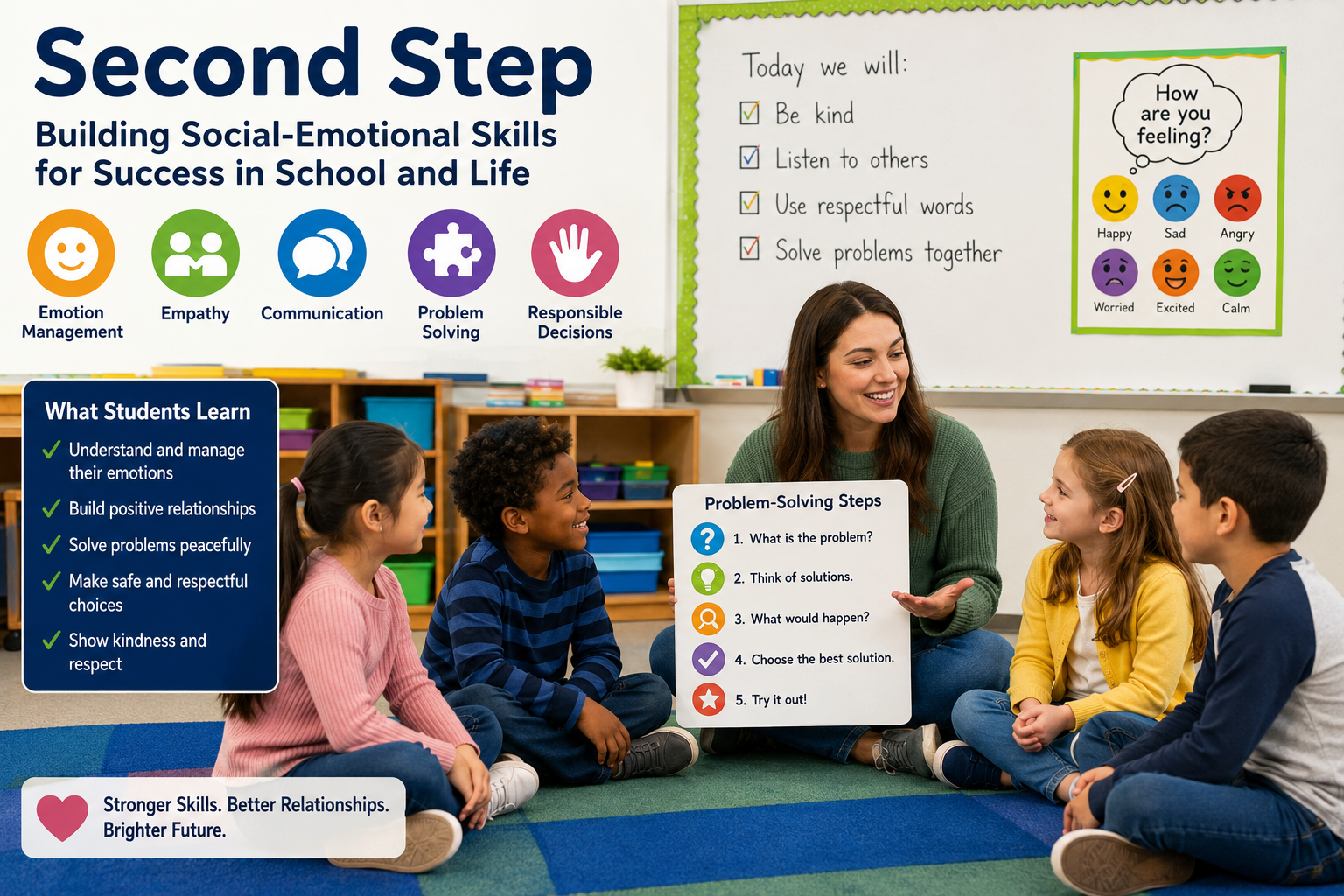
A child who can solve a conflict calmly, name their feelings, listen to others, and stay focused in class is not just “well behaved.” That child is learning life skills that shape school success, friendships, confidence, and future decision-making.
That is why many schools now pay serious attention to social-emotional learning, often called SEL. One of the most recognized names in this space is Second Step, a school-based program designed to help students build practical human skills such as empathy, emotion management, problem-solving, kindness, communication, and resilience.
But what does the program actually teach? Is it only for young children? How do teachers use it in real classrooms? And why are parents searching for it more often?
This guide explains the topic in simple English, without hype, confusion, or exaggerated claims.
What Is Second Step?
Second Step is an educational program used by schools to teach social-emotional learning and human skills. Instead of focusing only on academic subjects like math, reading, or science, it helps students learn how to understand emotions, build healthy relationships, make responsible choices, and handle everyday classroom challenges.
In practical terms, the curriculum may include short lessons, classroom discussions, videos, role-play activities, teacher guidance, and schoolwide tools. The goal is not to replace academic learning. The goal is to support it by helping students feel safer, calmer, more connected, and more ready to learn.
For example, a lesson may help a student understand what anger feels like in the body, how to pause before reacting, and how to choose words that do not hurt others. Another lesson may teach students how to recognize bullying, ask for help, or include a classmate who feels left out.
Why Schools Use SEL Programs
Teachers are not only managing lessons. They are also managing real human behavior every day. Students come to school with different home lives, stress levels, personalities, attention spans, and emotional needs.
A strong SEL program can help schools create a more consistent way to teach behavior and relationship skills.
Schools may use SEL lessons to help students:
- Listen respectfully during discussions
- Work better in groups
- Handle frustration without giving up
- Solve small conflicts before they become bigger
- Understand how their actions affect others
- Build confidence and classroom belonging
- Improve focus and readiness to learn
This matters because learning is harder when students feel unsafe, ignored, anxious, angry, or disconnected. A classroom with stronger emotional skills often becomes easier for both students and teachers.
What Students Learn in the Program
The curriculum usually focuses on age-appropriate skills. Younger children may learn simple ideas like identifying feelings, taking turns, calming down, and being kind. Older students may explore more complex topics such as peer pressure, goal-setting, stress, communication, and responsible decision-making.
Here is a simple overview:
| Skill Area | What It Means | Classroom Example |
|---|---|---|
| Emotion management | Understanding and controlling feelings | Taking deep breaths before reacting |
| Empathy | Understanding how others may feel | Noticing when a classmate is upset |
| Problem-solving | Finding safe and fair solutions | Talking through a disagreement |
| Communication | Using respectful words and listening | Explaining feelings without blaming |
| Responsibility | Thinking before making choices | Owning mistakes and making repairs |
| Belonging | Feeling included and valued | Building a kinder classroom culture |
These skills may sound simple, but they take practice. Children do not automatically know how to manage big emotions or solve social problems. Like reading or multiplication, these habits improve when they are taught clearly and repeated often.
How Teachers Use It in Classrooms
A good SEL lesson does not need to feel like a long lecture. In many classrooms, teachers use short, structured lessons that fit into the school week.
A typical lesson might include:
- A quick opening question
- A short video or story
- A discussion about a real-life situation
- A role-play or practice activity
- A reflection question
- A reminder to use the skill during the day
For example, if the lesson is about calming down, the teacher may ask students what frustration looks like. Then the class may discuss a situation such as losing a game or being interrupted. Students may practice a calm-down strategy, such as breathing slowly, counting, or asking for a break.
The most useful part is the follow-through. A lesson works better when teachers use the same language later in the hallway, cafeteria, playground, or group work. That consistency helps students connect the lesson to real life.
Is It Only for Elementary Students?
No. Many people associate SEL with young children, but social-emotional skills are important at every age.
Preschool students may need help naming emotions and learning classroom routines. Elementary students may need practice with friendship, fairness, and self-control. Middle school students may need support with identity, peer pressure, confidence, and conflict. High school students may benefit from lessons around stress, goals, communication, and future readiness.
The language changes with age, but the purpose stays similar: helping students understand themselves, respect others, and make better choices.
Why Parents Search for This Topic
Parents often search for this keyword because they receive a school notice, see the name in a curriculum list, or hear their child mention a lesson. Some parents want to know whether the program is about emotions, behavior, discipline, mental health, or values.
That curiosity is fair. Parents should understand what their children are learning.
In general, SEL programs are not meant to replace parenting or tell families what to believe. They are designed to give students practical tools for everyday school situations. Still, parents should always review their school’s materials, ask questions, and understand how the program is being taught locally.
Good questions parents can ask include:
- Which grade levels are using the curriculum?
- How often are lessons taught?
- Can parents view sample materials?
- How does the school handle sensitive topics?
- How are teachers trained to use the program?
- How does the school measure success?
These questions create healthy communication between families and schools.
Benefits of a Strong SEL Approach
When implemented well, SEL can support both academic and social growth. It gives teachers a shared language for behavior and gives students tools they can use beyond the classroom.
Possible benefits include:
- Better classroom climate
- More respectful peer relationships
- Improved student confidence
- Stronger emotional awareness
- Better conflict resolution
- More readiness to learn
- Fewer disruptions during lessons
However, no curriculum is magic. A program cannot fix every challenge by itself. It works best when teachers are trained, school leaders are supportive, parents are informed, and lessons are practiced consistently.
Limitations to Understand
A balanced article should not pretend that every program works perfectly in every school. The success of any SEL curriculum depends on how it is used.
Some common challenges include:
- Teachers may not have enough time
- Lessons may feel disconnected if not reinforced
- Schools may use the program inconsistently
- Parents may not receive enough explanation
- Students may need more support than classroom lessons alone
- Some topics may require cultural sensitivity and local review
The curriculum should be seen as one tool, not the entire solution. Students with serious emotional, behavioral, or mental health needs may require additional support from counselors, specialists, families, or healthcare professionals.
What Makes Helpful Content About This Topic Better?
Many articles about this subject are too thin. They simply define the program and stop there. A better article answers what real readers actually want to know.
Parents want clarity. Teachers want classroom usefulness. School leaders want practical implementation. Students need lessons that feel real, not forced.
Helpful content should explain:
- What the curriculum is
- Why schools use it
- What children learn
- How lessons look in real classrooms
- What parents should ask
- What benefits are realistic
- What limitations exist
This people-first approach is also better for modern search. Google increasingly rewards content that answers the real question clearly, avoids fake certainty, and provides original value rather than repeating the same generic lines found across many competing pages.
How to Support the Lessons at Home
Parents do not need to recreate a classroom curriculum at home. Small daily habits can support the same skills naturally.
For example:
- Ask your child how they solved a problem today
- Praise calm communication, not just good grades
- Help them name emotions instead of ignoring them
- Practice apologies and repair after conflict
- Model respectful disagreement
- Talk about kindness in real situations
- Encourage problem-solving before stepping in too quickly
A simple question like “What could you do differently next time?” can teach responsibility without shame. Over time, these conversations help children connect school lessons with real life.
Final Thoughts
Second Step is best understood as a practical SEL and human-skills curriculum for schools. Its purpose is to help students build emotional awareness, empathy, communication, problem-solving, and responsible decision-making.
For parents, the smartest approach is not to panic or blindly accept everything. Review what your school is teaching, ask clear questions, and look for how the lessons help children behave, connect, and learn better.
For teachers and schools, the key is consistency. A lesson matters most when students get to practice it in real situations, with adults who model the same skills.
In the end, children need more than facts and test scores. They also need the confidence and emotional tools to handle life. That is where a thoughtful SEL program can make a meaningful difference.
FAQs
What is Second Step in schools?
It is a school-based social-emotional learning curriculum that helps students develop skills like empathy, emotion management, problem-solving, communication, and responsible decision-making.
Is the program only about behavior?
No. Behavior is part of it, but the wider goal is to build human skills that support learning, relationships, confidence, and classroom belonging.
Can parents review the lessons?
In most cases, parents can ask the school for curriculum information, sample lessons, or details about how the program is being used. Policies may vary by district or school.
Does SEL replace academic learning?
No. SEL is designed to support academic learning by helping students focus, manage emotions, work with others, and participate more positively in class.
Is it useful for older students?
Yes. Older students also need support with stress, peer relationships, decision-making, communication, and future readiness. The lessons should be age-appropriate.
What should schools do before using it?
Schools should train teachers, communicate with families, review materials carefully, and make sure lessons are taught consistently across classrooms.
For more updates visit: THE SECOND STEP